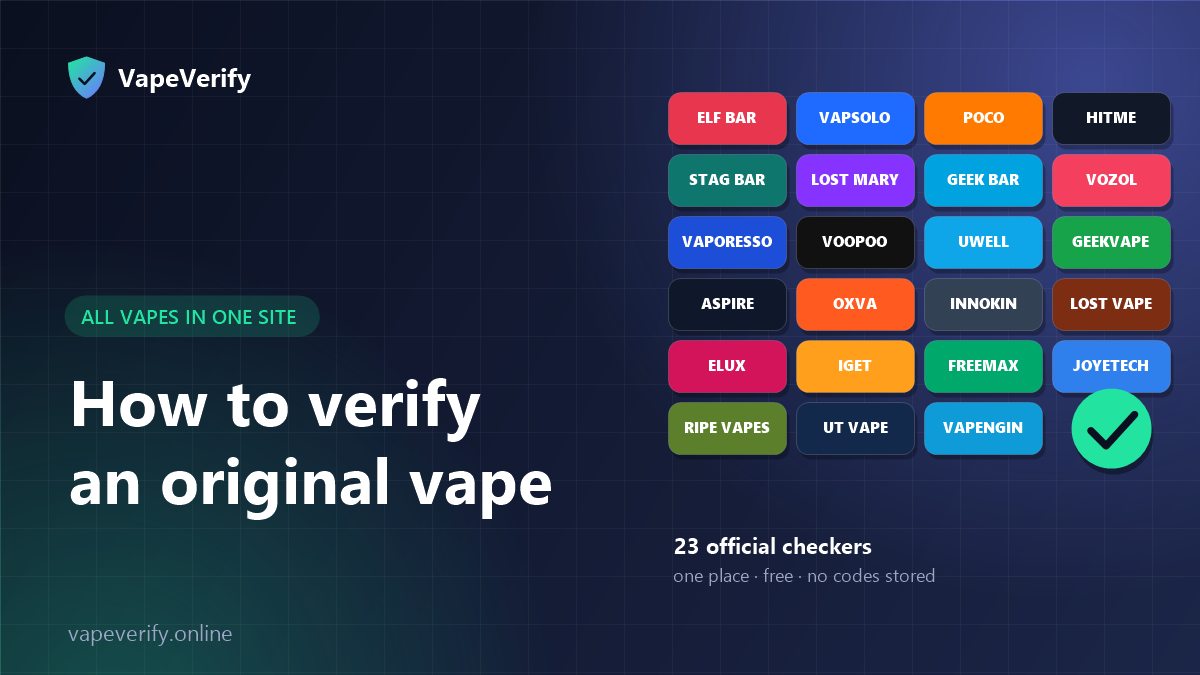
Counterfeit disposables and pod kits are now so well made that the box alone rarely gives them away – some even carry copied security codes and cloned QR stickers. This guide explains how to verify an original vape step by step: where the security code is, how to use the manufacturer’s official checker, which packaging and device details to compare, and what each result really means. Below you will also find every official checker we know of – 23 brands – collected in one place.
Key takeaways
- The security code check on the manufacturer’s own website is the deciding test – packaging and price are only warning signs.
- A QR code is only useful if it opens the brand’s real domain. Clone sites always answer “genuine”.
- “Already verified” on a sealed product usually means the code was copied onto fake boxes.
- Brands use different systems: scratch codes, QR scans, serial numbers, one-time codes and photo checks of a security seal.
- Buy from the brand or an established retailer, and be suspicious of prices far below the market.
Why authenticity checks matter
Counterfeit vapes are not a niche problem. Elf Bar alone reports that it has helped authorities seize more than 2 million fake finished products since 2021, and that 15 clone factories were shut down in 2024. Popular models are copied within weeks of launch, and the copies are sold in corner shops, on marketplaces and through social media ads.
The risk is not just paying for a fake. Counterfeit devices skip every quality control step: the e-liquid has an unknown composition and nicotine strength, the coil can be made from unsuitable metals, and the battery may lack basic protection. A counterfeit seized by Derby City Council in England was tested in a laboratory and found to contain arsenic, lead and formaldehyde. Manufacturers also warn about leaks, burnt hits and batteries that overheat while charging.
The good news: almost every major brand gives each product a unique security code and an official page where you can check it. If you know where to look, the whole check takes about two minutes.
5 checks to confirm a genuine vape
Work through these in order. The first two are decisive; the rest help you decide what to do when something feels off.
Find and reveal the security code
Turn the box over and look for the authentication label – usually on the side or back panel, often next to the barcode. Most labels hide the code under a silver scratch-off layer; some print a serial number directly on the pack.
- Scratch gently with a fingernail or coin so every character stays readable.
- Note the code format: 14, 16 or 18 characters is common, and some brands use a prefix (POCO codes start with “POCO”).
- Missing label or no code at all? That is already a warning sign – most brands put one on every product.
Check the code on the official website
Enter the code on the manufacturer’s own verification page, or scan the QR code – but always confirm where the QR code takes you.
- The result must appear on the brand’s real domain (for example elfbar.com, lostmary.com or vaporesso.com).
- A page you have never heard of that says “Genuine” proves nothing – counterfeiters print QR stickers that point to cloned checkers.
- The safest route is to open the official page yourself. On VapeVerify, every brand page links only to the official checker.
Inspect the packaging and the security label
Compare the box with the photos on the brand’s website. Counterfeit print is often slightly off in colour, blurry around the logo, or has typos in flavour names and health warnings.
- Holographic labels should shimmer and change as you tilt them; a flat printed copy does not.
- Some labels have hidden features: Elf Bar labels show a hidden marking under UV light, Freemax’s “X” logo switches through 360°, Vaporesso and VOOPOO labels have moving lens effects.
- Check that the seal and shrink wrap are intact.
Look at the device itself
Once you open it, the device should match the official model exactly – name, colour, logo position, mouthpiece and charging port.
- Very light weight, loose parts or rough seams are typical of clones.
- A burnt or chemical taste from the first puff, leaking, or a battery that dies long before the rated puff count are strong signs of a fake.
- If you suspect a counterfeit, do not charge it unattended and do not keep using it.
Question the seller and the price
Where you bought the product matters as much as the code. Large-puff disposables cost real money to make, so a brand-new model at a fraction of the usual price is rarely genuine.
- Social media ads promising “90% off” often lead to fake shops that send nothing or a counterfeit.
- Legitimate retailers show company details, an address and a working contact, and they check your age.
- Read our guide to scam vape shops for the full list of red flags.
The six types of verification
Not every brand checks authenticity the same way. Knowing which system your device uses saves time and prevents false “not found” results.
Scratch-off code
A code under a silver layer, entered on the brand’s site. Used by Stag Bar, GeekVape, Lost Vape and many others.
QR scan
Scan the label with your phone camera; the result opens on the brand’s domain. Recommended by Elf Bar for the most accurate result.
One-time code
Each code can be checked only once. Geek Bar uses this, so a sealed device that was “already checked” is suspicious.
Serial number
A serial number printed on the pack is checked against the brand’s database, as with Vapengin.
Photo or AI check
You photograph a code or seal instead of typing it. Ripe Vapes uses the Cypheme Security Seal; IGET, Uwell and VOZOL offer photo checks.
Query counter
The result shows how often a code was checked. IGET states that a code checked more than 3 times is fake; Stag Bar and ELUX show the history too.
All 23 official checkers in one place
Search for your brand or filter by device type. Each card shows how that brand verifies its products and links to our step-by-step guide, where the verify button opens the official checker.
Brand not listed yet? Look for a “Verify” or “Authenticity” page on the manufacturer’s own website, and check that you are on its real domain.
How VapeVerify works
VapeVerify is an independent guide, not a shop and not a manufacturer. For every brand it collects the official verification method – where the label is, what the code looks like and which page checks it – and sends you straight to that page. When a brand accepts codes in a link, your code is passed on directly; when it does not, the code is copied for you and the official page opens in a new tab, so you only need to paste it. Codes are never stored, and the redirect can only go to the brands’ official checkers.
Brand-specific tips for popular vapes
Each manufacturer has its own quirks. These are the details people most often miss.
Elf Bar
Old and new code formats are both in circulation, so Elf Bar recommends scanning the QR code for the most accurate result. The label also carries physical security features: under a UV lamp a hidden ELFBAR marking appears, and shading the label with a marker reveals the ELFBAR text. Our Elf Bar guide includes both official videos.
Lost Mary
The authentication label sits on the side of the box: a holographic sticker, a QR code and a scratch field that hides an 18-digit code. Enter all 18 digits – a missing digit is the most common reason for a failed check.
Geek Bar
Two label versions are genuine. The new one has a pink-to-blue header and hides a 4-digit verification code that you enter after scanning the QR; the old grey label shows the result straight away. Each code can be verified only once.
Vapsolo
Vapsolo updates its system regularly, so several sticker designs are original – a different-looking sticker alone does not mean a fake. Vapsolo also warns that its official store never offers cash on delivery.
POCO
The code starts with the letters POCO followed by digits. Scan the “Scan” QR on the side label or type the full code, including the prefix, on pocovape.com.
OXVA, Vaporesso and VOOPOO
These pod brands rely on holographic labels as well as codes. OXVA’s V2 label is laser-silver with a 3D embossed logo and a QR code, while V1 has a directional patterned texture. Vaporesso and VOOPOO labels show moving lens or shimmer effects when tilted.
Ripe Vapes
Ripe Vapes no longer uses a typed code: genuine products carry a Cypheme Security Seal that you photograph with your phone on the official verify page. Ripe Vapes says products with the old-style hologram are now almost all expired or counterfeit.
UT Vape and Vapengin
UT disposables are checked by entering the verification code on utvape.com, and UT openly warns about fake UT disposables. Vapengin uses the serial number printed on the pack – type it exactly as printed on vapengin.com.
What the result means
🧭 Result decoder
Click the message you got from the checker to see what it means and what to do next.
Genuine vs counterfeit: quick comparison
| Check | Genuine product | Likely counterfeit |
|---|---|---|
| Security code | Confirmed on the brand’s own site | Not found, or a sealed box shows many earlier checks |
| QR code | Opens the official brand domain | Opens a look-alike site that always says “genuine” |
| Security label | Hologram shifts, hidden features visible | Flat print, missing label or no scratch layer |
| Box print | Sharp logo, correct spelling, legal warnings | Blurry print, typos, odd spacing, missing warnings |
| Device | Matches the official model and specs | Wrong colour or logo, loose parts, light weight |
| First use | Clean flavour, steady vapour | Burnt or chemical taste, leaking, quick battery death |
| Price and seller | Normal market price from a known retailer | Far below market, social media ad, no company details |
Interactive risk check
Tick everything that applies to the product in front of you. The meter shows how worried you should be – but remember, only the official code check gives a definite answer.
Where to buy safely
The single best way to avoid counterfeits is to buy from the brand’s official store or from an established retailer that you can actually contact. Before you order from a shop you do not know, check that it lists a registered company, a physical address and working customer support; that it verifies your age; and that independent reviews (not just the ones on its own site) are positive. Pay with a method that lets you dispute the charge.
Be extra careful with offers on TikTok, Facebook and Instagram. Brands such as Vapsolo have warned about fake shops that copy their photos and logos, advertise “one piece $5” deals and offer cash on delivery on a site that pretends to be official. And remember that vape sales are regulated differently in every country – some restrict online or cross-border sales, flavours or disposables – so check the rules where you live.
What to do if your vape is fake
- Stop using it and do not charge it unattended.
- Keep the evidence: the box, the receipt and a screenshot of the failed check.
- Ask the seller for a refund. If you paid by card or PayPal and the seller refuses, contact your bank or PayPal.
- Report it to the brand – for example [email protected], [email protected], [email protected] or [email protected].
- Tell your consumer protection authority, especially if you bought it from a shop that claimed it was genuine.
Frequently asked questions
How do I check if my vape is original?
Find the authentication label on the box, reveal the security code, and enter it – or scan the QR code – on the manufacturer’s official verification page. Make sure the result appears on the brand’s real domain. VapeVerify links to the official checker for 23 brands.
Can a fake vape pass the QR code check?
Yes, if the QR code leads to a cloned website. Counterfeiters print QR stickers that open look-alike “verification” sites which always say genuine. Only trust a result on the brand’s own domain.
What does “this code has already been verified” mean?
The code exists, but someone has checked it before. If you checked it yourself, that is fine. If the device was sealed and new, the code was most likely copied onto several fake boxes.
Can I verify a vape without the box?
Usually not – the security code is on the packaging. Some brands print serial numbers on the device or offer photo checks, but in most cases you need the original box. Keep it until you have finished the device.
Is a vape fake if the code is not found?
Not immediately. First re-type the code and check that you selected the correct label version. If the official checker still cannot find it, treat the product as counterfeit.
Do all vape brands have a verification system?
Most major brands do, but the methods differ: scratch codes, QR codes, serial numbers, one-time codes or photo checks of a security seal. Smaller or unbranded products often have no official checker at all.
Are cheap vapes always fake?
No – but a brand-new, popular model offered far below the normal market price, especially through a social media ad, is a strong warning sign. Always finish with the official code check.
Does VapeVerify store my security code?
No. VapeVerify only counts how many checks are started; the code itself goes straight to the manufacturer’s official page and is not saved.
Check your vape now
Pick your brand, enter the code and get the answer from the manufacturer’s official system – free, in about two minutes.
Sources: the official verification pages of each brand listed above; ELFBAR statement on its global fight against counterfeit products; Derby City Council fake vape warning; Vapsolo anti-fraud notice.